How Wingspread plans every room setup, break, and menu around the result your team came to get
Picture the Tuesday after a big leadership offsite. The flip-chart pages are rolled up in someone’s trunk. Legal pads covered in arrows and circled words sit in a desk drawer, just under the expense report.
By Friday, the bold new strategy has turned into “let’s circle back on that,” and the team has gone back to doing exactly what it did before it left.
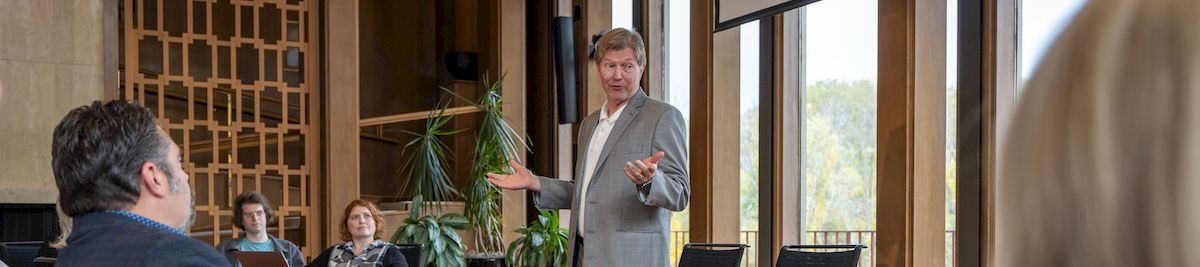
Eric Bates, General Manager of Wingspread, has watched that pattern play out across the meetings industry, and he has built his operation to prevent it.
The setting carries some history. The centerpiece is a Frank Lloyd Wright design completed in 1939 for the H.F. Johnson, Jr. family; for decades, it operated as a private facility and home to The Johnson Foundation before opening to public meeting use in 2018.
Today the campus includes three distinct buildings on 36 acres near the western shore of Lake Michigan. Joining him is Heather, Wingspread’s director of sales, who says Eric “walks, talks, breathes, and lives the magic of Wingspread every day.”
Wright Place, Right Outcome: Wingspread’s Results-First Retreats
The Notepad Graveyard
Leaders are not exactly fans of their own meetings.
In a Harvard Business Review study of 182 senior managers, 71% said their meetings were unproductive and inefficient, and 65% said meetings kept them from finishing their own work.
These are the people who schedule the meetings, yet they rate them as failures.
The offsite should be the exception. It costs more, pulls the most expensive people in the company away from their desks, and usually exists for decisions that never get made in a 30-minute video call.
Without a plan for what comes next, though, it runs straight into one of psychology’s oldest findings. Ebbinghaus documented the forgetting curve in the 1880s, and a modern replication by Murre and Dros again found recall dropping sharply soon after learning. (A note on the popular claim that people forget 90% within a week: researchers caution that those exact percentages are often wrongly credited to Ebbinghaus. The steep decline is real. The precise number depends on the person and the material.)
Eric describes the result without a single statistic. A forgettable meeting produces “a bunch of notes scribbled on a pad that someone’s gonna go back to the office and cast aside.”
Venue Math That Works Against You
The incentives of the average venue make this worse. Most hotels make money from occupied rooms, food-and-beverage minimums, and booked square footage.
A group that fills the ballroom and the room block counts as a success on the hotel’s books, whether or not the attendees decide anything.
That model rewards a venue for caring what happens on Monday morning.
Eric rejects that math directly. “We’re not interested in filling a meeting space. We’re not interested in putting... bodies in chairs or heads in beds, right?”
That is an unusual thing for a general manager to say out loud, since most properties keep score by filled chairs and beds. It also changes the questions his team asks when a planner calls.
Planning Backward From Monday Morning
At Wingspread, the planning process begins with the result the group wants and works backward to every logistical decision.
Eric lists the questions his team works through:
“When we talk about what’s the most effective way to set the room, what’s the most effective timing for breaks, what’s the most thought-provoking team-building that we can do, how do we make the food tie into the general health and wellness of the attendees? All of those sorts of things aren’t for us to fill a meeting space.”
Each item on his list is backed by research.
Break timing is one example. Microsoft’s Human Factors Lab measured brain activity in volunteers during back-to-back meetings and found that stress-related beta wave activity kept climbing over two straight hours with no breaks.
When they added short breaks, beta activity held steady, and participants showed signs of greater engagement. A coffee break is part of the meeting’s design, not just a pause in the agenda.
Room sets work the same way.
Theater seating suits groups that need to listen.
Pods suit small teams solving problems.
Facing chairs with no table between them suit groups that have to settle a disagreement.
Food matters too: a heavy pasta lunch before a 2 p.m. strategy session reliably produces drowsy executives.
Then there is memory. In one well-known study, students who practiced recalling a passage retained 56% of it a week later, compared with 42% for students who simply reread it.
Team-building that has attendees use and argue through ideas, rather than just hear them, gives those ideas a better chance of surviving the drive home.
As Eric puts it: “All those things are for us to help you get the result that you came to get.”
The Premium Question
Eric is direct about price. “Yes, the meetings here are a little bit more executive level. They’re a little bit more expensive.”
The comparison that matters is cost per result, not cost per head.
A cheaper offsite that produces nothing has still consumed two days of senior leadership time, travel, and the opportunity cost of everything those leaders could have done instead. The expensive meeting changes nothing.
Eric describes what clients get for the extra spend: “They actually get work done that results in things changing when they get back to the office.”
For planners, that gives a useful standard for any venue.
Ask whether the sales team wants to know what the group is trying to decide. Ask whether break timing is built around attention or around the kitchen’s schedule. Ask whether anyone has thought about how the menu affects the afternoon session.
A venue that responds with a banquet event order before asking about your objective is telling you how it measures success.
Plan the Meeting Your Team Remembers on Monday
If your next leadership retreat has to change something, start with what you want to be different when everyone gets back to the office. Wingspread’s planning team will work backward from there, setting the room, timing the breaks, and planning the menu around that goal.
Reach out to Heather and the sales team at wingspread.com or call 262-833-1484 to start the conversation. Bring your toughest agenda item.