Match the Environment to the Outcome, Not the Other Way Around
Every year, meeting planners make the same bet. They book the rooftop, the resort, the city with the skyline that photographs well. They sell it upstairs as an investment in culture, in team, in experience. And then their senior leadership team spends the first morning of a two-day strategic planning retreat arguing about whether to do the sunset cruise before or after dinner.
The meeting never really recovers.
Heather Roose has watched this play out more times than she can count. As a venue professional at Wingspread, she spends her days thinking about how environments actually affect people, not just what they look like on a site visit.
Her conclusion is both simple and routinely ignored: the wrong environment doesn't just fail to help. It actively works against you.
When the Room Has a Better Agenda Than You Do
Here is what nobody puts in the post-event survey. Half the executive team was up until 1 a.m. at the hotel bar. Two people skipped the morning session for a spa appointment that had been on the books since before the flight. One attendee spent the entire afternoon breakout session mentally composing a Yelp review of the dinner from the night before because it was that good.
None of this registers as a failure of venue selection. It registers as low engagement, "we need a better facilitator," or a scheduling problem. But the environment created every single one of those outcomes.
Roose frames it this way: "When attendees get so distracted that they forget why they're there, because there's so much other stuff going on, it's all about having the right environment to foster the type of outcome that you want."
That word, foster, is doing a lot of work. Environments don't just host behavior. They produce it. This is not a soft claim. Cognitive science has spent decades documenting what designers and architects have long known intuitively: novel, stimulating environments tax working memory. Your brain, encountering something unfamiliar and exciting, allocates resources toward processing that novelty. The resources it pulls from are the same ones you were planning to use for the hard conversation about Q3 projections.
A Las Vegas ballroom is not a neutral container for your content. It is a competing agenda.
The Instagram Problem Has a Name Now
There is pressure on planners that did not exist ten years ago, at least not at this intensity. The "sexy destination" has become a deliverable in its own right. It goes in the post-event recap deck. It generates organic content. It functions as proof that the organization invests in its people.
Roose acknowledges this pressure without dismissing it. "If it's an incentive trip, then of course go to the next hot destination, 'cause everybody's gonna wanna Instagram that moment." Reward travel is a different contract. The whole point is the experience, and a high-stimulation environment honestly delivers on that contract.
But the contract for a strategic offsite is different. And when planners apply incentive-trip logic to working meetings, they are solving the wrong problem with the right solution. The resulting event looks great in photos and produces very little that anyone can act on.
The honest version of that slide in the recap deck would read: "We spent $400,000 to give our leadership team an experience they mostly talked about instead of doing the work we flew them there to do."
What Slowing Down Actually Looks Like
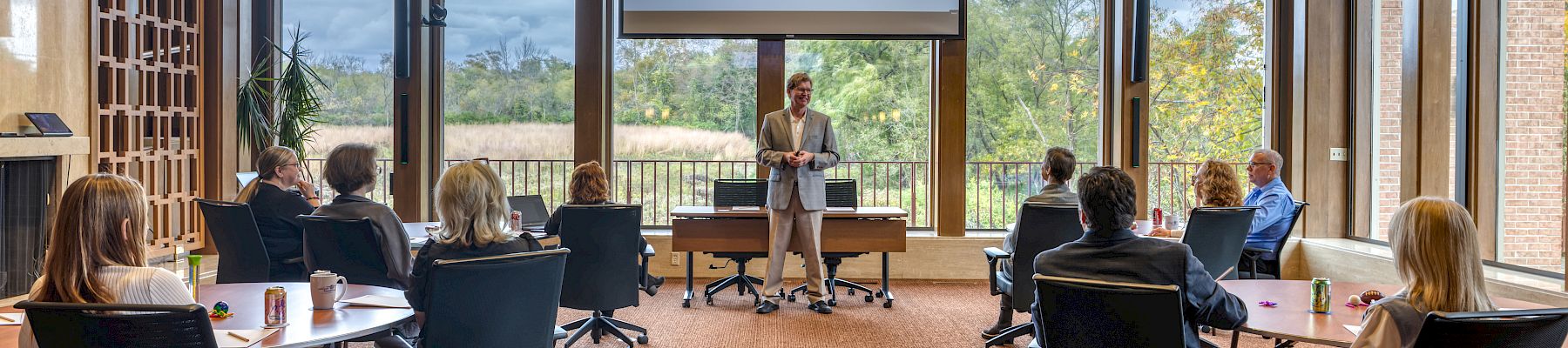
Wingspread offers a useful counterexample, and not because it is rustic or deliberately low-stimulation in a punishing way. It is genuinely beautiful. Wright's horizontal prairie architecture, the 14,000-square-foot main house, the grounds that roll toward Lake Michigan. It is not a sacrifice.
But the stimulation it offers is of a different kind.
"When you drive into Wingspread, you're either coming from Lake Michigan, or you're coming from a country road," Roose explains. "And when people drive in, they get distracted because they're like, 'Oh my gosh, there's the deer. Oh, there's turkeys.' And so it opens up this whole conversation and people start talking about nature and their past experiences with nature."
Notice what that distraction produces. It produces conversation. Low-stakes, personal, human conversation of exactly the kind that softens people up before they have to navigate something difficult together. It is not the absence of stimulation. It is stimulation that runs in the same direction as the meeting's purpose rather than against it.
Roose describes attendees who arrive wound tight and visibly decompress within hours. "They instantly slow down. They settle in. Our spaces are residential style, so people feel at home. They relax. It opens people up to more honesty when they're comfortable." People write in journals there, she notes, not because anyone asks them to, but because the environment makes it feel like the obvious thing to do.
That is environment as facilitation. It is doing work that no agenda item, icebreaker, or facilitator can fully replicate.
The Planner's Actual Job
Meeting planners are often evaluated on things that are easy to measure: budget adherence, attendee satisfaction scores, whether the AV worked. They are rarely evaluated on whether the meeting produced a decision that held, or a conversation that changed a relationship, or a strategy that people actually implemented when they got home.
This evaluation gap is part of why the sexy destination keeps winning the internal pitch. It is easier to defend a beautiful hotel than a quiet estate outside Racine. One sells itself on a site tour. The other requires the planner to argue about epistemology and cognitive load, which is a hard sell to the budget committee.
Roose's advice cuts through it: "If your goal is discussions, alignment, problem-solving, and fellowship, if you go somewhere where it doesn't have the distractions, you have more engagement." She is not arguing against attractive venues. She is arguing for clarity about what the meeting is actually for.
The question she is implicitly asking planners to answer before they open a single proposal is this: what do you need people to be able to do, and what kind of environment makes that more or less likely?
Book the Room That Matches the Work
The best meeting venues are not the ones that make the strongest case for themselves during a site visit. They are the ones that disappear into the work once everyone arrives, where the setting becomes context rather than content, where attendees stop narrating their experience and start having it.
That is a harder thing to find than a good rooftop bar, and a much harder thing to sell. But the meetings that produce something real, the decisions that stick, the alignments that last past the flight home, tend to happen in rooms that knew their job and stayed in their lane.
As Roose puts it: "You wanna align your meeting or your event with your goals."
Before the venue search begins, that is the only question that matters.
The Right Environment Is Waiting
If your next meeting needs to produce something real, Wingspread Retreat & Executive Conference Center was built for exactly that. Thirty-six acres in Wind Point, WI. A Frank Lloyd Wright-designed main house. Residential spaces that make people feel settled enough to say the thing they wouldn't say in a hotel ballroom. No casino. No spa waitlist. No competing agenda.
Reach out to us here to explore the space and start a conversation about your next event.